Cloud computing is now so normal that most organisations barely think twice about where their data lives. It sits in “the cloud”, it works, it’s secure, and everyone moves on. Yet behind the scenes, a quieter but increasingly important conversation is taking place in boardrooms, regulator meetings and procurement discussions. That conversation is about sovereignty.
Sovereign cloud is one of those terms that sounds technical but is actually very human. At its heart, it asks a simple question: who ultimately controls your data? Not just where the servers are physically located, but whose laws apply, who can access the systems, and whether a foreign government could legally demand that information be handed over.
Many organisations assume that if their data is stored in UK data centres, the problem is solved. In reality, that only covers data residency. Sovereignty goes further. It looks at legal control, operational control and jurisdiction. If your cloud provider is headquartered overseas, then overseas laws may still apply, even if the data never leaves the UK.
This is no longer a niche concern. A decade ago, cloud conversations were about cost savings, convenience and basic security. Today, the landscape feels different. Regulatory scrutiny is higher. Public trust is more fragile. Geopolitical tensions are real. Supply chains are under the microscope. And legislation such as the US CLOUD Act has sharpened awareness that governments can compel their domestic companies to provide access to data, even when that data is held abroad. That does not mean intelligence agencies are casually browsing corporate systems, but it does mean that legal exposure exists, and for some sectors that matters.
For most organisations using mainstream cloud services in the UK, the current position is broadly reassuring. If you are running workloads in Azure UK South or UK West, or in AWS’s London region, your data is physically stored in the UK and you are meeting UK GDPR requirements. These platforms are highly secure and widely trusted. For the majority of businesses, this is entirely appropriate and proportionate.
The distinction appears when you look at more sensitive environments such as healthcare, central government, defence, policing, or heavily regulated industries. These sectors are increasingly expected to demonstrate not just that their data is secure, but that they understand who governs it and under which legal framework. It becomes an assurance question rather than a purely technical one.
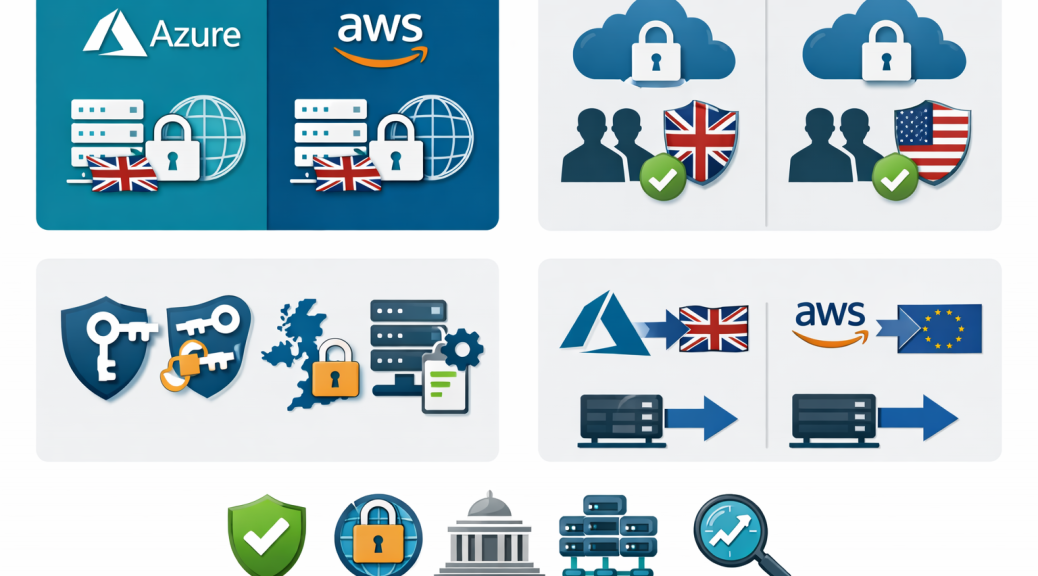
This is where the difference between the big cloud providers begins to show. Microsoft has spent years building dedicated environments for public sector use. Azure UK Government provides separate cloud environments designed specifically for UK public sector workloads, with tighter controls around access, operations and governance. These platforms are already in real-world use across government departments, local authorities and parts of the NHS. Alongside this, Microsoft has introduced a wide range of sovereignty controls into its mainstream cloud, including advanced customer-controlled encryption, strong data boundary commitments and deep transparency over administrative access. The effect is that organisations can evidence control, not just assume it.
AWS, by contrast, has historically focused on delivering a single, highly secure global platform. Its UK regions are robust, compliant and technically excellent, but there is currently no UK-specific sovereign environment equivalent to Azure UK Government. AWS does operate GovCloud, but that platform is built exclusively for US government workloads and is not available for UK use. Recognising the growing demand for sovereignty, AWS has announced a European Sovereign Cloud, designed to operate under a separate European legal entity with European staff and governance, explicitly addressing concerns about foreign legal reach. It is an important move and a clear signal of where the market is going, but it is still in development rather than mainstream reality.
The risk itself is often misunderstood. This is not about suggesting that cloud providers are unsafe or untrustworthy. For most organisations, the chance of foreign government access to their data is extremely low. The more realistic risk lies in accountability. Regulators, auditors and clients are increasingly asking tougher questions. They want organisations to demonstrate that they understand their data flows, their legal exposure and their governance model. Simply saying “it’s in the cloud” is no longer enough in some sectors.
The direction of travel is clear. Governments want greater national control over sensitive data. Regulators want stronger assurance. Customers want transparency. Cloud providers are responding by creating sovereign offerings, embedding more governance controls and, in some cases, structurally separating their sovereign platforms from their global ones. What feels like an emerging topic today will likely become standard language in architecture documents and procurement frameworks within a few years.
For now, the practical picture is straightforward. Azure UK and AWS UK are both secure, compliant and suitable for most use cases. Neither represents full legal sovereignty in the strictest sense. Microsoft currently offers more mature options for UK public sector and regulated environments. AWS is investing heavily to close that gap. Understanding this distinction does not mean organisations need to panic, but it does mean they can have more informed conversations, make better decisions and answer the harder questions with confidence when they inevitably arise.
Azure vs AWS – Sovereignty Comparison (UK perspective)
| Area | Microsoft Azure | Amazon Web Services (AWS) |
|---|---|---|
| UK data centres | Yes (UK South, UK West) | Yes (London region) |
| Data residency (UK GDPR) | Yes | Yes |
| US parent company | Yes | Yes |
| Subject to US legal reach (e.g. CLOUD Act) | Theoretically yes | Theoretically yes |
| Fully sovereign by default | No | No |
| Suitable for most commercial use | Yes | Yes |
Summary: both platforms are compliant and safe for most organisations, but neither is fully sovereign in standard form.
Public Sector and Higher-Assurance Environments
| Area | Azure UK Government | AWS GovCloud |
|---|---|---|
| Available to UK organisations | Yes | No (US only) |
| Designed for UK government use | Yes | No |
| Separate cloud environment | Yes | Yes |
| Access restricted to national personnel | Yes (UK personnel) | Yes (US personnel only) |
| Used by government / defence | Yes (UK) | Yes (US only) |
| Practical UK sovereignty | Yes | Not applicable |
Summary: Azure currently offers a real UK sovereign-grade environment. AWS does not yet.
Sovereignty Controls and Governance Features
| Capability | Azure | AWS |
|---|---|---|
| Customer-managed encryption keys | Yes | Yes |
| Double Key Encryption (extra legal control) | Yes | No equivalent |
| Strong data boundary commitments (UK/EU) | Yes | Limited |
| Customer control over support access | Strong controls | More limited |
| Native tooling for compliance evidence | Strong | Moderate |
| Easier to defend in UK audits | Yes | More challenging |
Summary: Azure provides more built-in features for proving governance and sovereignty.
Future Direction
| Area | Azure | AWS |
|---|---|---|
| Sovereign strategy | Already active (UK Gov + controls) | European Sovereign Cloud announced |
| Separate legal entity for sovereign cloud | Partial (controls-based model) | Yes (planned EU entity) |
| Market maturity | Live and in use | Still being built |
| Direction of travel | Embedding sovereignty into core cloud | Structurally separating sovereign cloud |
Summary: Microsoft is ahead today. AWS is investing heavily to catch up.
Plain-English takeaway table
| Question | Answer |
|---|---|
| Are Azure UK and AWS UK safe and compliant? | Yes |
| Are they fully sovereign by default? | No |
| Does Azure offer a UK sovereign option today? | Yes (Azure UK Government) |
| Does AWS offer a UK sovereign option today? | No |
| Is AWS building one? | Yes (European Sovereign Cloud) |
| Will sovereignty matter more in future? | Almost certainly |