
The Ancient Warning
“Come, let us build ourselves a city, with a tower that reaches to the heavens… so that we may make a name for ourselves.”
— Genesis 11:4
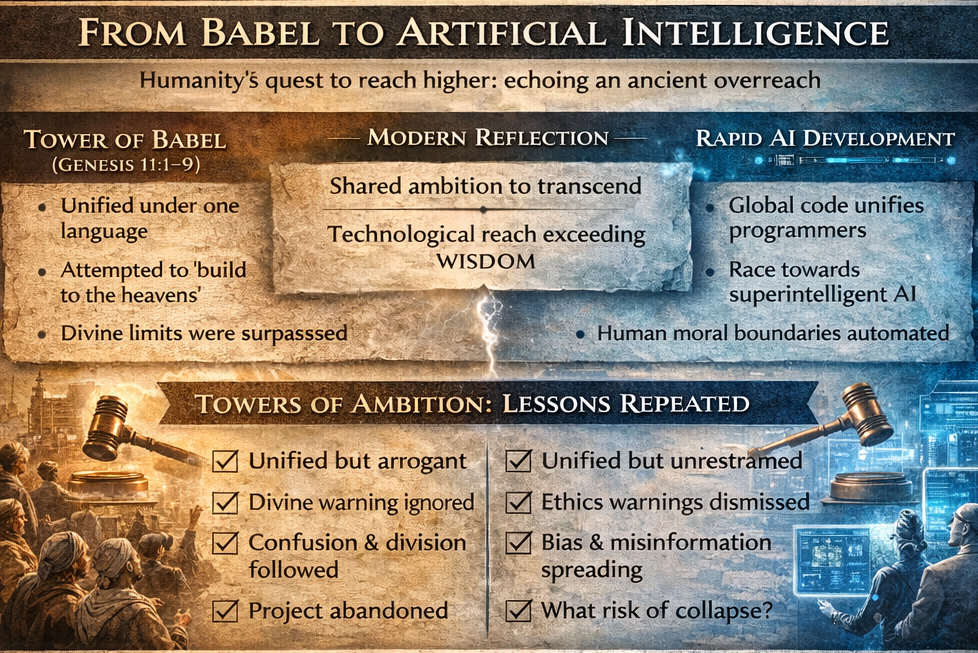
In the biblical story of the Tower of Babel, humanity’s unified ambition to reach the heavens is interrupted by divine intervention. Language is confounded, and the people are scattered—ambition halted by humility.
Today, we are building again. But this time, the tower is digital.
A New Kind of Tower
Generative AI has evolved from novel concept to global phenomenon in under two years. According to McKinsey, 79% of professionals have used generative AI, and 40% of companies plan to increase investment because of it. It’s not just a tool—it’s becoming infrastructure.
Like Babel, the AI revolution is underpinned by a common tongue: programming languages, machine learning models, and vast data sets shared across borders.
But if language once unified us, today it might divide us again.
When Truth Becomes Output
AI systems don’t know truth—they generate plausible output. And yet, many of us trust them to write job descriptions, flag criminal risk, draft news summaries, and moderate online discourse.
In one widely used AI legal system (COMPAS), Black defendants were twice as likely to be wrongly labelled “high risk” compared to white defendants.
Less than 32% of companies using generative AI are actively addressing its risk of inaccuracy
AI tools like ChatGPT can produce elegant lies, mistaken citations, and confident hallucinations—often accepted as fact by users.
What happens when truth is no longer verified, but assumed from an algorithm’s answer?
Machines Can Judge, But Not Conscience
A key difference between human judgement and machine output is empathy. AI does not feel remorse. It cannot be held accountable. It does not understand suffering.
And yet, we are deploying it in:
- Judicial settings (bail, sentencing recommendations)
- Hiring and firing decisions
- Medical triage
- Political content moderation
“An algorithm can replicate moral reasoning, but it cannot possess moral responsibility.”
Just because AI can decide, doesn’t mean it should.
Parallels With Babel
| Babel | Today’s AI Landscape |
|---|---|
| One language united humanity | Shared AI platforms and coding languages |
| Tower to reach the heavens | Drive toward artificial general intelligence |
| Collapse from confusion | Fragmentation through misinformation and automation bias |
| Human ambition without humility | AI ambition without ethical guardrails |
In both cases, the pursuit of greatness lacked grounding in wisdom and restraint.
The Risks of Letting Go
The Tower of Babel failed because people tried to unify around something they didn’t fully understand. Similarly, today’s overreliance on AI risks:
- Automation bias: deferring to AI even when it’s wrong
- Opacity: not knowing how decisions were made
- Moral displacement: letting machines guide decisions that require empathy
- Erosion of accountability: no clear person responsible for AI decisions
Without deliberate human oversight, we risk building systems that scale injustice, not eliminate it.
What Should We Do Differently?
Not halt AI—but build it better. The lesson from Babel isn’t to stop building—it’s to build with wisdom, humility, and shared ethics.
That means:
Embedding human-in-the-loop systems
Ensuring transparency and explainability
Establishing ethical AI design standards
Preserving conscience as the ultimate decision-maker
As Bryan Avery’s AI readiness model puts it:
“Artificial intelligence applied when needed. Emotional intelligence applied as standard.”Unlocking Opportunities with AI…
Final Thought
If we let AI define truth and justice, we risk forgetting how to hear the still, small voice of human conscience. And once that voice is quieted, the machine won’t bring it back.
Let us not build a tower that forgets the ground beneath our feet.
References:
Microsoft Copilot adoption and ethical AI design
https://link.technologyadvice.com/r/microsoft-copilot-tr-microsoft-copilot-cheat-sheet
– Covers how Microsoft’s AI tools are being deployed and the standards around responsible use.
McKinsey’s Global AI Survey (2024): AI adoption and risk
https://www.mckinsey.com/capabilities/mckinsey-digital/our-insights/the-state-of-ai-in-2023-generative-ais-breakout-year
– Documents business usage trends, governance concerns, and ethical gaps in generative AI deployment.
Microsoft Responsible AI Standard v2 (2023)
https://www.microsoft.com/en-us/ai/responsible-ai
– Outlines guiding principles on fairness, accountability, and human oversight in AI systems.