Introduction
Software development has evolved rapidly, and with it, the need for robust security practices has never been greater. Across industries, organizations are embracing DevSecOps—a methodology that integrates security into every stage of the development lifecycle. This shift is essential because open-source adoption has skyrocketed, growing from just 36% of codebases in 2015 to 75% in 2020. While this trend accelerates innovation, it also introduces significant risks. High-profile breaches, such as the SolarWinds attack, have demonstrated how vulnerable the software supply chain can be when security is not prioritized.
To address these challenges, Artificial Intelligence (AI) is emerging as a transformative force, enabling DevSecOps teams to move from reactive security measures to proactive, intelligent protection.
The Role of Software Composition Analysis
One of the most critical components of modern DevSecOps is Software Composition Analysis (SCA). SCA tools help organisations identify vulnerabilities in open-source and third-party components, enforce compliance with licensing requirements, and generate Software Bills of Materials (SBOMs), a key requirement for many regulatory frameworks and government contracts. These capabilities are vital for maintaining transparency and trust in the software supply chain.
However, implementing SCA at scale is not without challenges. Many leading tools struggle to support air-gapped environments, which are common in highly secure deployments. Maintaining separate solutions for connected and disconnected environments can be costly and operationally complex. Additionally, even minimal data shared externally, such as fingerprints of open-source packages, can expose sensitive information about an organization’s technology stack.
How AI Transforms DevSecOps
AI introduces intelligence and automation into every stage of the DevSecOps pipeline. Instead of relying solely on static scans and manual reviews, AI-driven systems can analyze patterns, predict risks, and recommend solutions in real time.
First, AI enhances vulnerability detection by identifying risky dependencies and predicting emerging threats based on historical exploit trends. It also improves risk prioritisation, ranking vulnerabilities by exploit likelihood and business impact so teams can focus on the most critical issues. When it comes to remediation, AI offers smart suggestions, recommending safe patches or alternative libraries and validating compatibility to reduce the risk of breaking builds.
AI also plays a key role in compliance monitoring. By mapping open-source usage against industry standards and organizational policies, AI can automate license checks and generate SBOMs without manual intervention. In addition, AI strengthens supply chain security by detecting anomalies in dependency graphs and flagging suspicious packages, helping prevent attacks like dependency confusion.
For organizations operating in air-gapped environments, AI can even forecast update cycles and optimize data transfer schedules, reducing manual effort and ensuring systems remain secure.
The AI-Augmented DevSecOps Pipeline
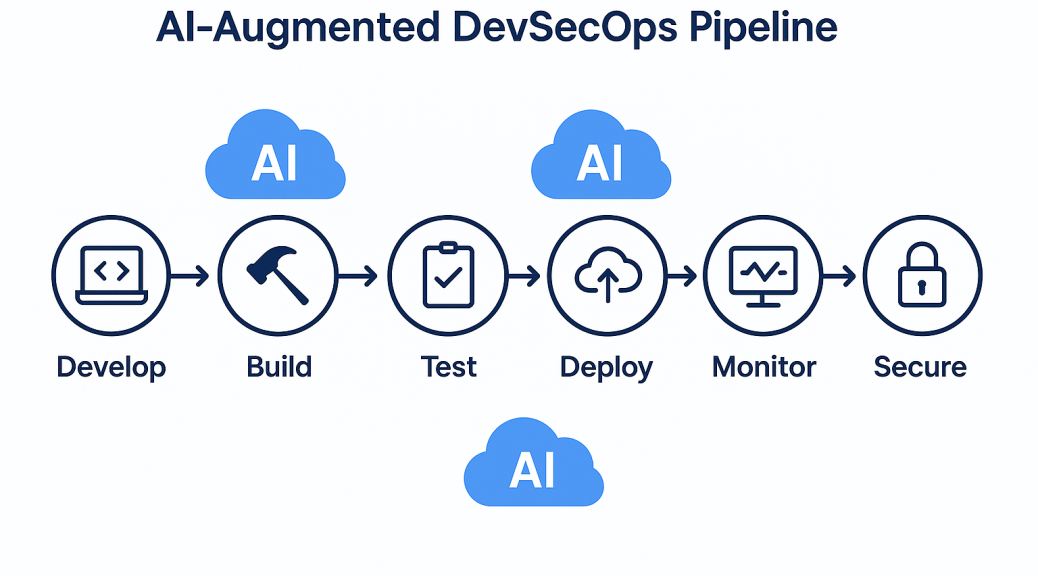
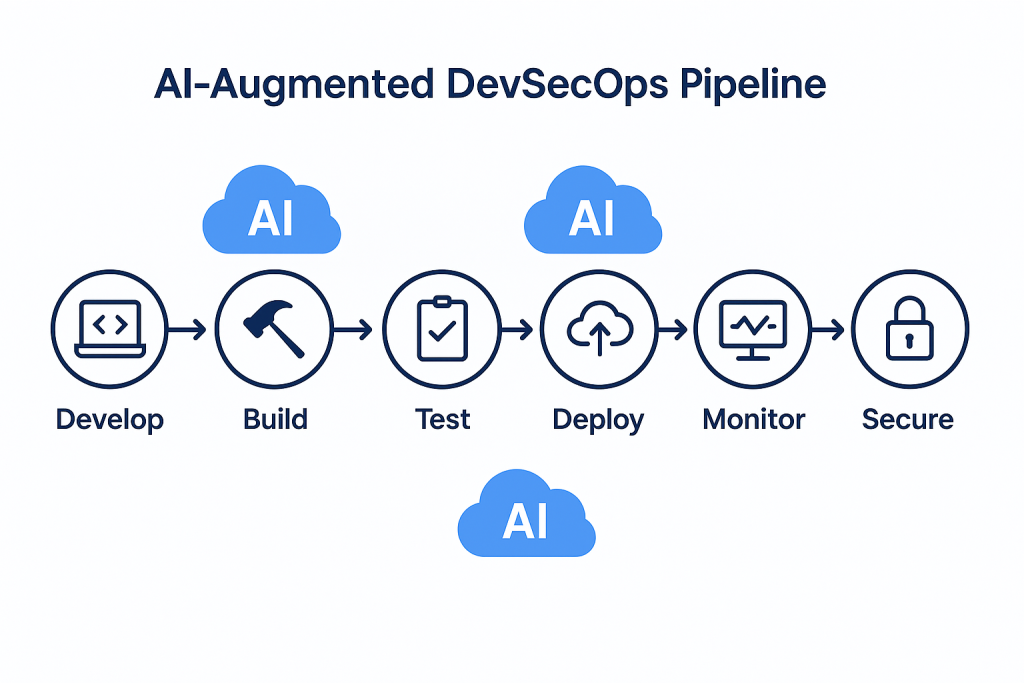
AI can be embedded throughout the DevSecOps lifecycle. During development, it provides secure coding suggestions and automatically generates SBOMs. In the build phase, AI performs vulnerability scanning and dependency risk analysis. During testing, it prioritizes issues and recommends safe fixes. At deployment, AI predicts risks and validates supply chain integrity. Post-deployment, AI continuously monitors for anomalies and enforces compliance. Finally, AI supports proactive threat intelligence and policy automation to maintain security over time.
Best Practices for Industry Adoption
To fully leverage AI in DevSecOps, organizations should integrate AI-driven security checks early in the development process. Automating SBOM generation ensures compliance and transparency, while hybrid strategies can balance connectivity for both online and air-gapped environments. Finally, strict governance policies should be implemented to manage any external data sharing.
Conclusion
AI is no longer a luxury, it is a necessity for modern DevSecOps. By embedding intelligence into vulnerability detection, compliance, and remediation workflows, organizations can achieve a proactive security posture, reduce operational overhead, and safeguard the software supply chain against evolving threats.