As artificial intelligence permeates everyday life, society faces a provocative question: are we ceding our definitions of truth and justice to machines? From AI-powered news feeds that shape what we see as “true” to algorithms advising judges on sentences, the influence of AI on moral and legal decisions is growing. Tech giants tout AI systems – from generative chatbots like ChatGPT to decision tools in courts and HR departments – as unbiased and efficient. Yet observers worry that by increasingly relying on AI to decide what is true and what is fair, we risk outsourcing our own moral judgement. Could an AI, even one designed to sound human, ever replace the human conscience that guides ethical decisions? This article explores the consequences of this shift, drawing on expert insights and current examples to challenge readers to critically consider how far we should entrust truth and justice to algorithms.
AI-Generated “Truth” and the Risk of Misinformation
Artificial intelligence is already a powerful gatekeeper of information. Generative AI models can produce confident answers and realistic content on demand – but that doesn’t guarantee truth. In fact, 77% of businesses express concern about AI “hallucinations” – the tendency of AI like large language models to invent false information – and 47% of enterprise AI users admitted making at least one major decision based on AI-generated false content in 2024 fullview.io. The convenience of an AI assistant that can answer any question or draft any report also brings a deceptive aura of authority. Users may assume that if an answer is detailed and fluent, it must be correct, blurring the line between accuracy and truth. A United Nations University analysis warns that “when accuracy is confused with truth, there is a high risk of harm, especially in fields where human judgment and ethical considerations are critical.”unu.edu In other words, an AI system can be technically accurate according to its training data and still be fundamentally untrue or misleading in context – a dangerous scenario if we start accepting AI outputs uncritically as the “ground truth.”
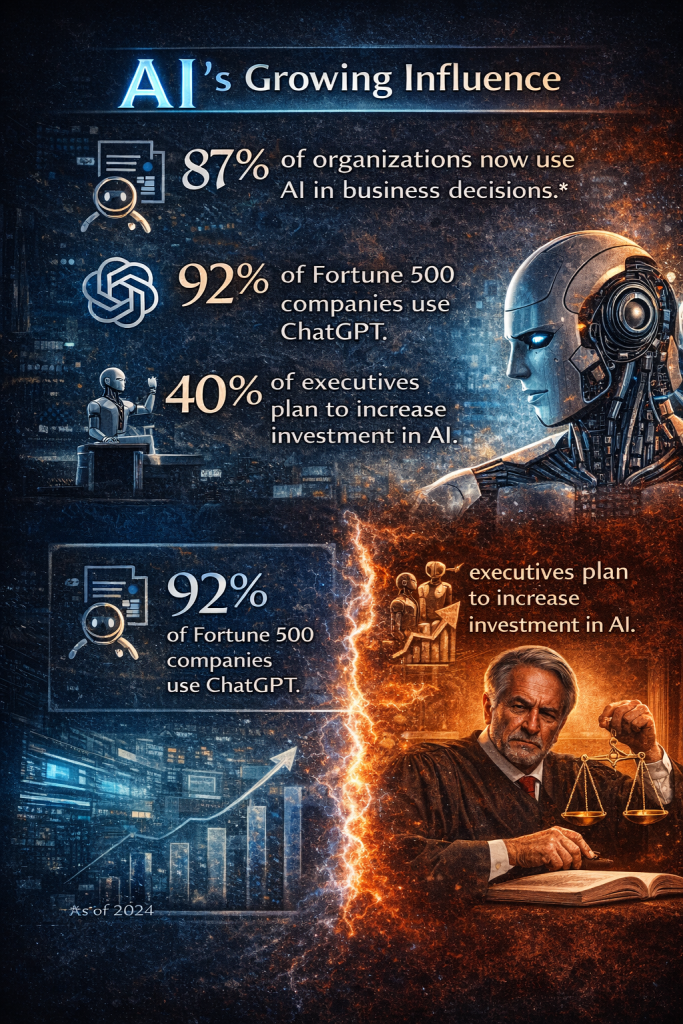
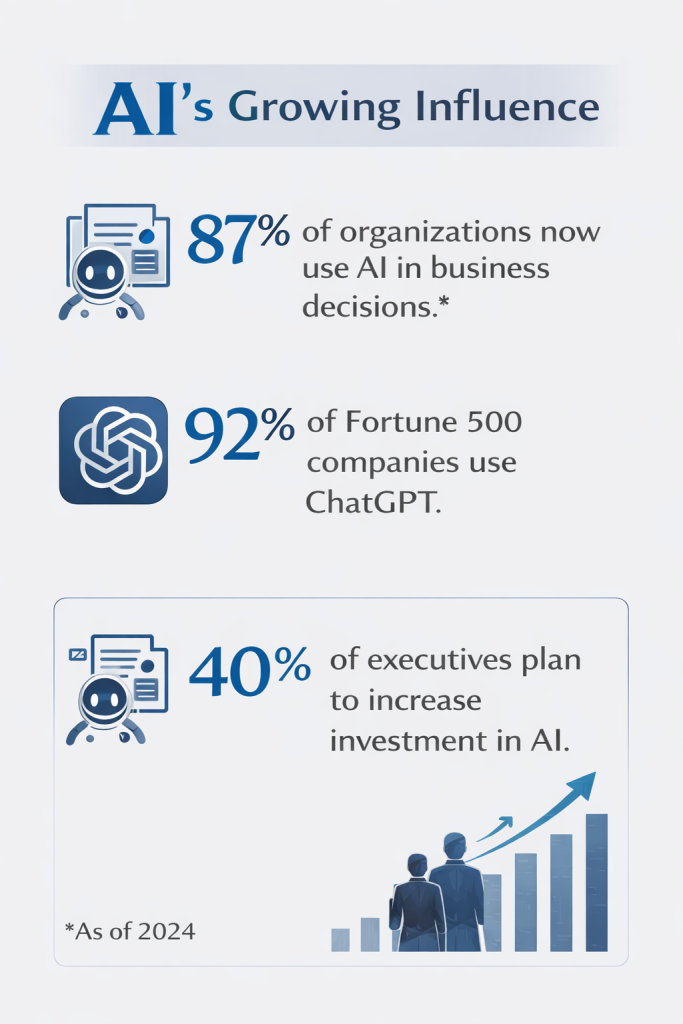
This risk is far from hypothetical. ChatGPT and similar generative AI tools have already been caught confidently fabricating facts, yet they are rapidly being adopted in workplaces and media. Less than a year after its debut, 92% of Fortune 500 companies had employees using ChatGPT for assistance fullview.io. Overall AI adoption has surged – 78% of organizations now use AI in at least one business function, up from 55% in 2023 fullview.io – but governance lags behind. One industry survey in 2025 found that only 27% of companies review all generative AI outputs before release; most rely on spot checks or trust the AI by default workforcesolutionsnews.com. In effect, many organisations are letting algorithms define information presented as fact, without fully vetting the results. That approach can backfire spectacularly: consider the embarrassment of a legal team that submitted an AI-written brief citing nonexistent cases, or a medical chatbot offering unsound health advice that a human professional would instantly flag. Such incidents underscore that AI’s “knowledge” is ultimately a reflection of its training data and programming – not an independent arbiter of truth. If we allow AI systems to become authoritative sources by virtue of their ubiquity, we risk a future where facts are whatever an algorithm outputs, and errors or biases at scale could misinform millions.
AI’s role in content moderation and online discourse also raises red flags. Social media platforms deploy AI filters to decide what speech is permissible or which posts get promoted. These algorithms, while faster than human moderators, can carry hidden political or cultural biases. For example, an analysis of one AI content moderation system found it flagged identical derogatory comments differently depending on the target – negative comments about women were much more often tagged as “hateful” than the same comments about men manhattan.institute. And the system was more permissive of hateful remarks aimed at conservatives than the exact same slurs directed at liberals, suggesting an embedded political tilt manhattan.institute. If such automated gatekeepers consistently err in one direction, they could silently skew public discourse. Indeed, some researchers caution that if AI systems like chatbots or recommendation algorithms become ubiquitous while carrying systematic political biases, they may increase societal polarisation manhattan.institute. The prospect of AI-defined “truth” is thus double-edged: on one hand, AI might counter human misinformation by quickly debunking falsehoods; on the other, it might produce convincing falsehoods or biased outputs of its own. The critical question is whether we will have the wisdom and transparency to discern the difference.
Algorithmic Justice: AI in Law and the Courts
Perhaps nowhere is the tension between AI efficiency and human conscience more stark than in the justice system. Courts around the world have begun experimenting with AI tools – from risk assessment algorithms that guide judges in sentencing and bail decisions to AI systems that research case law or even draft judgments. Supporters argue that AI can make legal outcomes more consistent and free from human prejudices. However, when it comes to defining justice, the limitations of these systems are alarming. Criminal sentencing provides a cautionary tale: A widely used algorithm in US courts, COMPAS, analyzes defendants’ data to predict their likelihood of reoffending. While the goal is to aid judges with data-driven objectivity, in practice COMPAS demonstrated troubling racial bias. A landmark ProPublica investigation found the tool was almost twice as likely to falsely label Black defendants as high-risk compared to white defendants rev.com. In other words, an algorithm purported to improve fairness was systematically harsher on one group, reflecting biases in the underlying data (historical crime and policing records) rather than any objective reality of “dangerousness.” This sparked a debate nationwide about bias in “algorithmic justice” and whether such tools inadvertently encode and legitimize the very disparities the legal system seeks to eliminate.
Courts have wrestled with how to incorporate these AI recommendations. In the 2016 State v. Loomis case, the Wisconsin Supreme Court allowed the use of COMPAS scores in sentencing decisions but warned judges not to rely on them exclusively, acknowledging both the tool’s potential utility and its serious limitations rev.com. This illustrates a vital point: AI might assist human decision-makers, but it cannot replace them in moral and legal reasoning. The human judge bears responsibility to temper data with judgment. Indeed, the ongoing evidence suggests that without careful checks, AI may simply make biased or unjust decisions faster. A 2024 study by Tulane University found that an AI-assisted sentencing system, while reducing jail time on average for some low-risk offenders, still disproportionately flagged minority defendants as high risk – effectively automating unequal treatment under the law rev.com. As the study dryly noted, unless we resolve these bias issues, AI tools may only make unfair sentencing “faster,” not fairer rev.com.
Beyond sentencing, AI is being eyed for roles like evaluating evidence or even acting as a virtual judge in small disputes, raising further ethical questions. Legal experts emphasize that justice is not just a data problem to optimize. It involves empathy, context, mercy, and the nuanced application of values – factors an algorithm struggles to grasp. “The challenge is to balance innovation with justice; the tools must support – not replace – the human judgement so central to a fair legal system,” writes legal analyst Luke Daugherty rev.com. Efficiency cannot come at the cost of equity. An AI might calculate a recidivism risk score with great precision, but it cannot appreciate the individual story behind a defendant or the moral weight of punishing versus forgiving. Nor can it be held accountable in the way society expects of a human judge or juror. In the realm of law, an unjust decision – even if efficiently arrived at – is not true justice at all. This is why many jurists insist that algorithms in court be kept on a short leash: useful for insight, perhaps, but ultimately subordinated to human conscience and common sense.
Algorithms at Work: AI in Hiring and Social Decisions
The push to hand off decision-making to AI is not limited to courts or content feeds – it’s happening in workplaces and society at large. Human resources departments, for instance, have turned to AI tools to screen CVs, rank job candidates, and even predict employee performance. The promise is tempting: removing human bias and gut-feel from hiring could yield fairer, merit-based decisions. The reality, however, has often been the opposite. A famous example came from Amazon, which developed an experimental AI recruiting engine to streamline hiring. The result? Amazon’s machine-learning tool taught itself that male candidates were preferable to female ones, because it was trained on ten years of resumes the company received – most of which came from men in the male-dominated tech industry reuters.com. The AI system began penalising resumes that contained the word “women’s” (as in “women’s chess club captain”) and downgraded graduates of women’s colleges reuters.com. In effect, the algorithm imbibed past bias and regurgitated it as an objective hiring criterion. Amazon’s engineers tried to correct for this once the issue was discovered, but they rightly lost confidence – if the AI wasn’t explicitly sexist, it might find other, more subtle ways to discriminate. The project was scrapped before it could do real harm, but it serves as a stark warning: without extreme care, AI decision tools can simply automate old prejudices under a veneer of algorithmic impartiality.
This problem is not just theoretical. Regulators are increasingly alert to AI-driven discrimination. In one case, a company called iTutorGroup faced action from the U.S. Equal Employment Opportunity Commission after its hiring algorithm was found to be rejecting older applicants en masse, purely based on age – a blatant violation of employment law workforcesolutionsnews.com. The incident showed how an AI designed to optimise a hiring process can collide with human values and legal standards (in this case, age diversity and anti-discrimination laws). It’s a reminder that “efficient” outcomes by an AI are not necessarily equitable outcomes. Hiring and firing affect livelihoods and dignity, and involve ethical judgments about bias, diversity, and second chances that a narrow AI metric might not capture. If managers simply defer to an algorithm’s recommendations (“the computer says this applicant isn’t a good fit”), there is a risk that meaningful human oversight and fairness checks fall by the wayside.
AI’s influence on social and political decisions is also fraught with unintended consequences. We’ve seen social media algorithms, guided by AI, amplify certain types of content to maximise engagement – sometimes to society’s detriment by spreading outrage or misinformation. AI moderation tools can likewise err. They might mistakenly flag satire or activism as “hate speech” or “disinformation”, or conversely fail to catch harmful content if it’s phrased in a way the AI doesn’t recognise manhattan.instituteoversightboard.com. This raises thorny questions: Who defines the community standards these AIs enforce, and what happens when the AI gets it wrong? Unlike a human moderator, an AI cannot easily be reasoned with or asked for an explanation; its judgment is often a black box. Moreover, the scale is immense – an automated system making thousands of moderation decisions per second could shape the very landscape of public discourse without most users realising it. If we allow AI systems to become the de facto arbiters of what can be said (and by whom) in digital society, we risk normalising a kind of algorithmic governance that lacks transparency and appeals process. In political contexts, this could be dangerous: imagine an AI inadvertently biased against a certain vernacular or culture controlling which political ads are approved, or which grassroots posts are suppressed. The result could tilt the playing field of democracy. In short, while AI can help manage the enormous scale of modern digital life, ceding too much control to it in social decisions might undermine the human values – like free expression and fairness – that we seek to uphold.
The Human Conscience vs. the Algorithm
Why can’t an advanced AI serve as a perfectly logical judge or an unbiased hiring manager? The fundamental reason is that AI lacks the very qualities that constitute a moral conscience. An AI, no matter how sophisticated, is not a sentient being with empathy, compassion, or an inherent sense of right and wrong. As one philosopher put it, “AI itself cannot be a moral agent” – it can mimic decision-making but cannot truly understand the moral weight of its choices stories.tamu.edu. Unlike humans, an AI has no free will or awareness; it follows its programming and data patterns. This means if an AI system causes harm, the blame lies not on the machine – which has no concept of blame – but on its human creators and operators stories.tamu.edu. In essence, an AI can produce the same outputs a human might, but it does so without understanding. It will not lose sleep over an unfair verdict it recommended, or feel remorse if its recommendation inflicts suffering. A human judge or manager, imperfect as they are, can at least strive to act conscientiously and live with the moral consequences; a machine cannot.
This gap between computation and conscience gives rise to several inherent limitations of AI-driven decisions in ethical domains:
- Lack of Context and Insight: AI systems are context-blind. They excel at detecting patterns in the data they are given, but they lack a full understanding of real-world nuances, cultures, and individual circumstances cometanalysis.com. For instance, an algorithm might note a person has had three job changes in two years and flag them as a “risk,” whereas a human might discover those moves were due to family caregiving needs – a factor of human life no algorithm would infer from raw data. Human judgment can incorporate intangible context; AI cannot truly step outside its programmed parameters.
- No Genuine Empathy or Mercy: Human conscience allows for empathy – the ability to put oneself in another’s shoes – and for mercy – the choice to give someone a second chance or the benefit of the doubt. AI lacks these faculties entirely. It cannot understand pain, hope, or ethical duty. This is why, for example, philosophers caution against overreliance on AI in roles like mental health support or education, where empathy and “practical wisdom” (what Aristotle called phronesis) are crucial stories.tamu.edustories.tamu.edu. An AI might simulate a friendly counsellor well, but we shouldn’t be fooled into thinking the AI ‘understands’ us in any human sense stories.tamu.edu.
- Bias In, Bias Out: Despite hopes that AI would be more objective than humans, it inevitably inherits biases present in its training data. If historical data reflect social biases, the AI will likely perpetuate them unu.edu. Moreover, AI’s notion of “fair” is only as good as the mathematical criteria we define – which are hotly debated, as seen in the COMPAS example. AI has no innate moral compass to detect bias; only careful human oversight can identify and correct it, and even that is challenging when the AI’s decision process is opaque.
- False Confidence and Automation Bias: AI systems often present their outputs with supreme confidence – a neatly calculated score, a definitive recommendation – giving users a false sense of certainty cometanalysis.com. This can lure humans into what experts call automation bias: a tendency to trust the machine’s decision more than one’s own judgment. For instance, pilots and doctors have been known to occasionally override their own instincts in deference to an automated system (sometimes with dire results). In corporate or legal settings, a manager might accept an AI’s flawed recommendation without question because it looks data-driven and authoritative cometanalysis.com. Such deference is dangerous. As AI ethicist Tshilidzi Marwala notes, high accuracy in output is not the same as truth or wisdom – and confusing the two can lead to serious harm unu.eduunu.edu. Critical thinking and healthy skepticism are needed more than ever when dealing with AI outputs.
- Accountability Gaps: With human decision-makers, we expect accountability – a judge must justify a ruling, a CEO can be fired for poor decisions. But when an AI system makes a decision or prediction, who is accountable if it goes wrong? The responsibility technically falls to the humans deploying it, but in practice this can become a grey area. Companies have sometimes deflected blame by saying “the algorithm made a mistake,” as if that absolves them. Society has yet to fully work out legal and moral accountability in cases where AI systems cause harm. What is clear is that an AI itself cannot be “accountable” in the way a person is – it cannot answer for its actions or learn a moral lesson from an error. This means any system where AI plays a major role must build in human accountability and the ability for humans to override or question the machine. Otherwise we end up with decisions made by unanswerable black boxes, a scenario no ethical society should accept.
Each of these limitations illustrates why human conscience and oversight remain indispensable. We can delegate number-crunching and data-sifting to machines, but delegating moral reasoning is another matter. As one safety engineering firm concluded after studying AI in high-risk industries: AI should augment human expertise, not automate it, in any arena where lives, rights or livelihoods are on the line cometanalysis.comcometanalysis.com. Even the most advanced AI lacks the holistic understanding, ethical intuition, and sense of responsibility that a human decision-maker brings. Our challenge is to harness AI’s strengths – consistency, speed, analytical power – without relinquishing the human values and judgment that define justice and truth.
Striving for Responsible AI: Keeping Humans in the Loop
Given the profound risks and limitations outlined above, how are we as a society responding? Both governments and businesses are waking up to the need for responsible AI practices that ensure these technologies are used in alignment with human values. Around the world, regulators are drafting rules to rein in AI’s dangers while preserving its benefits. The European Union has led the way with a comprehensive AI Act, a risk-based regulatory framework that will impose strict requirements on “high-risk” AI systems (such as those used in law enforcement, hiring, or credit scoring) to ensure they are transparent, explainable, and free from prohibited biases. In contrast, the United Kingdom so far favours a more “light-touch” approach, avoiding sweeping AI-specific laws in favour of guidance and existing regulations – though the UK government has signalled it will regulate the most powerful AI models soon epthinktank.euepthinktank.eu. Both approaches seek a balance: foster innovation in AI, but not at the expense of rights and safety. Likewise, the United States is exploring AI oversight, from the White House’s non-binding AI Bill of Rights blueprint to various legislative proposals, aiming to prevent AI-driven discrimination and ensure AI systems are auditable. Notably, dozens of countries (including EU members, the UK, and the US) have also signed onto international agreements like the Council of Europe’s Convention on AI and Human Rights, pledging to develop AI in ways that uphold equality, democracy and the rule of law epthinktank.eu.
Corporate players, too, recognize that trust in AI is essential and fragile. In the wake of AI controversies, many tech companies have published their own ethical AI principles. Common themes have emerged – fairness, transparency, accountability, privacy, and security are often cited as the five key pillars of responsible AI use professional.dce.harvard.edu. In practical terms, these principles mean companies are committing (at least on paper) to test their algorithms for bias, explain their AI’s decision logic where possible, protect user data, and maintain human oversight. For example, IBM has an AI Ethics Board to review sensitive projects, Google famously developed AI ethics guidelines (like avoiding applications that violate human rights), and Microsoft established an Office of Responsible AI to integrate ethical considerations into product development. The reality of implementation can be messy – there have been instances of companies disbanding ethics teams or rushing AI features to market despite internal objections – but the trend indicates growing awareness that unchecked AI development poses reputational and legal risks. A Harvard analysis notes that businesses racing ahead with AI without governance face “bruised reputations, stakeholder divestment, [and] talent flight” if things go wrong professional.dce.harvard.edu. In other words, it’s in a company’s own interest to avoid an AI scandal where their tool is found to be biased or harmful.
Concrete measures are emerging. Firms are beginning to conduct bias audits on AI models, use more diverse training data, and implement “human-in-the-loop” systems where AI suggestions must be reviewed and approved by people. Many organisations now train staff on the limitations of AI and how to use it ethically workforcesolutionsnews.com. Some are even buying insurance against AI failures and creating incident response plans for AI glitches. Yet, a gap remains between principle and practice. Surveys show that while companies acknowledge AI risks, most have not fully addressed them – for instance, only about 21% of companies using AI have established policies guiding employees on proper AI use at work, and less than half are actively mitigating even the AI risks they deem most relevant mckinsey.com. It appears we are in the early days of developing an AI “conscience” in our institutions. The intentions are there, but robust safeguards and oversight mechanisms are still catching up with the breakneck pace of AI adoption.
Ultimately, the goal of responsible AI efforts is not to halt progress, but to ensure progress doesn’t steamroll over human values. Government rules and corporate ethics charters alike seek to draw lines: for example, saying an AI should assist a judge but never hand down a sentence on its own, or that an AI hiring program must be auditable for bias and subject to human review before rejecting candidates. These checks and balances are about keeping humans in control. As one industry safety report put it, even as AI grows more capable, “certain decisions should always remain in human hands.” cometanalysis.comcometanalysis.com That speaks to a widely held conviction: We can enjoy the efficiency and insights of AI, but when it comes to decisions of truth and justice – decisions that shape lives and society – we should not abdicate responsibility. Instead, AI should be a tool that operates under the guidance of human conscience. The hope is that with smart regulation, transparent design, and a culture of ethical awareness, we can harness AI in ways that enhance human judgement – for example, by catching inconsistencies or offering data-driven perspectives – without replacing the intangible moral and emotional intelligence that makes us human.
Conclusion: A New Age of Wisdom or Worry?
The rise of AI in defining truth and justice presents us with both exciting opportunities and disquieting dilemmas. On one hand, we have at our disposal tools of unprecedented power – algorithms that can sift truth from lies across billions of documents in seconds, or predictive models that could help judges and managers make more informed, consistent decisions. There is a genuine hope that, used wisely, AI could reduce human errors, cut through personal prejudices, and point us toward fairer outcomes. On the other hand, as we have seen, these tools are fundamentally limited by the absence of human conscience and understanding. They can as easily scale up biases as eliminate them. They can give an illusion of objectivity and overwhelm our critical faculties. And they raise the spectre of moral abdication: that we might gradually stop exercising our own judgement and compassion, content to let machines decide what is true or just.
So will artificial intelligence supplant human moral judgement? The most honest answer today is: only if we let it. AI cannot “replace” the human conscience in any literal sense – a machine does not possess empathy, guilt, love, or principles – but we can certainly choose to ignore our conscience and follow the machine’s outputs blindly. The controversial, thought-provoking challenge before us is to resist that temptation. As individuals, that means staying informed and skeptical about AI-generated information, and remembering that truth requires human context and verification. As communities and organisations, it means insisting on human accountability and oversight for AI-driven decisions. As a society, it may mean drawing red lines (through laws or norms) about decisions that we refuse to delegate to AI, no matter how advanced – be it final say in criminal sentencing, life-and-death medical triage, or other profoundly human judgements.
In the end, truth and justice are not mere computational problems; they are products of human values, debate, and yes, sometimes human imperfection. An algorithm might analyse past data to suggest an answer, but it takes a human conscience to ask “Should we?” rather than just “Can we?”. Perhaps the real promise of this AI age is not that machines will render us morally obsolete, but that they will force us to reaffirm the very qualities that make us human. By confronting us with ultra-rational, unfeeling decision-makers, AI can highlight the importance of empathy, context, and moral responsibility in our choices. The hope is that we will rise to the occasion – using AI to inform and improve our judgement, but never to erase it. As we stand at this crossroads, the ultimate verdict on AI’s role in truth and justice will depend on our collective vigilance and wisdom. It’s a test of conscience for all of us: will we let convenience and automation numb our moral instincts, or will we critically engage with these tools and ensure they reflect our highest values? The answer may well determine the character of our society in the years to come.